
Technology
Nvidia director sold nearly $1B in stock weeks before the Jensen Huang scandal
By Marcus Chen
Advertisement · Why this ad?
Katherine oversees editorial operations across all six brands. Before joining The Meridan Group, she spent 14 years at the Minneapolis Star Tribune, where she led the metro desk through its digital transformation. She holds a Master's in Journalism from Northwestern's Medill School.
More from Katherine →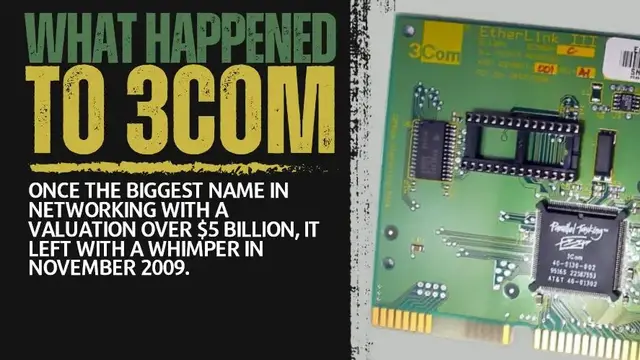
The steady hum of a server room, the satisfying click of a network cable – these are sounds that once defined an era of technological innovation. Few companies embodied that era as distinctly as 3Com, a name synonymous with reliable networking hardware in the 1980s and 1990s. Today, that name is largely absent from the landscape of modern technology, a quiet fade rather than a dramatic collapse. On November 11, 2009, Hewlett-Packard acquired what remained of 3Com for $2.7 billion, effectively marking the end of an iconic chapter in American business—a story of ambition, missteps, and ultimately, assimilation into a larger corporate entity. Hewlett-Packard’s acquisition serves as a stark reminder that even seemingly invincible companies can succumb to the shifting currents of technological progress and poor strategic decisions.
Founded in 1979 by Bob Metcalfe, co-inventor of Ethernet, 3Com rapidly ascended to prominence during the dotcom boom. Around the time of the boom, 3Com was a $5.8 billion company. They became the go-to brand for network cards, and for two decades, their cards were known for their reliability, driver support, and U.S.-based manufacturing—an increasingly rare practice in a globalizing economy. While the 3C501 network card earned a less-than-stellar reputation, other models from the 1980s and 1990s were renowned for their quality. “No one got fired for buying 3Com,” a sentiment echoing the similar feeling surrounding IBM during the personal computer revolution.
The company’s success wasn't just about quality; it was also about trust. In some shops, only three brands of network equipment were permitted: 3Com, Cisco, and Intel. If a user plugged in a no-name NE2000 clone card and encountered problems, the IT department would replace it and bill the user’s department. 3Com even secured the naming rights to Candlestick Park in San Francisco in 1995, a testament to its perceived dominance, holding those rights until 2002.
However, the bursting of the dotcom bubble signaled a downturn for 3Com. The subsequent years were characterized by a series of decisions that eroded profitability and ultimately led to its demise. A pivotal moment was the company’s withdrawal from the enterprise networking equipment business, a move analysts found perplexing given it didn’t yield any cost savings. This decision alienated customers and dealers, many of whom shifted to Intel cards—a consequence 3Com could have likely foreseen. As one commentator noted at the time, “There is always the fear that two vendors will point fingers at each other,” highlighting a fundamental challenge in maintaining interoperability within networking systems.
Further complicating matters was 3Com’s foray into unrelated businesses, most notably the acquisition of US Robotics, a maker of modems and Palm Pilots. While initially appearing promising, this acquisition proved costly as 3Com overpaid for products with a limited shelf life. The company paid a premium price for products with a limited shelf life left in them. Nothing good happened to 3Com after this acquisition. It took only three years for Cisco to go from being 90% the size of 3Com to double its size.
The decision to acquire US Robotics and its modem business at a time when broadband internet access was rapidly becoming the dominant technology proved disastrous. This bet was akin to investing in America Online while overlooking the rise of AT&T’s broader telecommunications infrastructure. 3Com had no plan to get into the broadband business, and minimum viable product-style modems undercut US Robotics modems, just like the network card business. The company’s inability to adapt to the evolving technological landscape ultimately sealed its fate.
Even attempts at strategic partnerships, including discussions with the Chinese networking giant Huawei, proved fruitless. There were rumors of Huawei buying 3Com, though that deal never went through. While 3Com began manufacturing products overseas to reduce costs, these measures were insufficient to overcome the accumulated losses and missed opportunities. As Intel undercut their price to try to gain market share, 3Com's profitability dropped.
Following 3Com’s acquisition by HP in 2009, the company’s network equipment business was largely subsumed into HP's existing product lineup. Today, 3Com is a distant memory, with its network cards now branded under HP or the newer Aruba brand. The selling point is now the price being lower than Cisco’s. HP will usually beat Cisco’s price, and if the IT department is under pressure to reduce the number of vendors it buys from, HP sells more things than Cisco.
However, if HP is trying to control costs, network cards now simply have a sticker. The intellectual property and assets of 3Com are now integrated into HP’s networking division, albeit without the same prominence. Vintage 3Com network cards remain popular among retro computing enthusiasts, valued for their reliability and compatibility with legacy hardware. These cards often provide a period-correct aesthetic and functionality for recreating the computing environments of the 1980s and 1990s. For example, a 3c509 ISA card or 3c905 PCI card are excellent choices for systems from the 286 to the Pentium II era.
The story of 3Com is a cautionary tale about the perils of complacency and the importance of adaptability in a rapidly changing world. It’s easy, looking back, to identify the missteps—the retreat from enterprise networking, the ill-fated acquisition of US Robotics—but the reality is that even astute business leaders can be blindsided by unforeseen technological shifts. What’s particularly striking is how a company built on a foundation of reliability and quality could lose its way. The erosion of trust, both among customers and within the company itself, appears to have been a key factor in its downfall.
As families navigate the complexities of modern life—the constant pressure to adapt to new technologies, the shifting economic landscape—the story of 3Com serves as a reminder that even established institutions are not immune to disruption. It highlights the importance of fostering a culture of innovation, embracing change, and maintaining a long-term perspective.
Closing paragraph: The fate of 3Com prompts reflection on the fragility of even well-established businesses and the constant need for adaptation in a dynamic technological landscape. While its story concludes with an acquisition, the lessons gleaned from its rise and fall remain relevant for businesses and communities alike – a testament to the enduring value of resilience, innovation, and a steadfast commitment to enduring principles.
Shenzhen
Technology
Friday, November 13, 2026
5 min
By Marcus Chen

By Katherine Langford

By Katherine Langford

By Marcus Chen